
Frequently Asked Questions
Tackle for squid fishing (egi, sutte, puradzuno)
Q1.What is the difference between a sutte and an egi?
A1.There is no strict definition, but they differ in shape and in how they are used. An egi is said to have originally been modelled on a shrimp; it is usually fished on its own, cast or worked tip-run style. A sutte has a cloth-wrapped body and is often used several at a time, on a dropper rig or as a dropper. KEYSTONE also groups its products into “egi for aori squid” and “egi and sutte for kensaki, spear and Japanese common squid”. When targeting kensaki, spear or Japanese common squid, both egi and sutte are used.
Q2.What is a sutte?
A2.A squid lure with a cloth-wrapped body. It is used from boats for kensaki, spear and Japanese common squid, often several at a time on a dropper rig or as a dropper. There are floating sutte that stay up in the water, lead sutte that sink, and bait-wrapped sutte.
Q3.What is a floating sutte (uki-sutte)?
A3.A sutte that does not sink. Tied to a branch line of a dropper rig, it takes the current and sways in the water. KEYSTONE makes two: the Vivin Sutte, blow-moulded in the traditional way, and the Hard Foam Floating Sutte, made of rigid urethane foam. The Vivin Sutte has a thick body rated to a depth of 200 m; the Hard Foam Floating Sutte has a slim body that still carries a dedicated “yari-ika” crown hook.
Q4.What is the difference between a puradzuno and a sutte?
A4.A puradzuno is usually made of polycarbonate or ABS resin. Most of them have very little buoyancy, and they work by the reflection and colour of the body itself to attract kensaki squid, Japanese common squid and the like. A sutte has a cloth-wrapped body, and comes in floating and sinking types. KEYSTONE’s Ukipla Hybrid Hook is 110 mm long and as slim as a puradzuno, yet made buoyant with rigid urethane foam and finished with cloth like a sutte — which is why it is called a hybrid.
Q5.Is it true that bite feel is an important factor?
A5.Yes. Bite feel here means how hard the surface of the material is. ABS resin, used in things like ballpoint pens, TV remote controls and toys, has a very hard surface that is difficult to scratch with a fingernail. Rigid urethane foam, on the other hand, is a very hard material, yet its surface is only hard enough that pressing firmly with a fingernail will leave a mark, and a squid's beak (teeth) sinks into the surface of the body. This surface, neither too hard nor too soft, gives a natural bite feel when a squid bites in, so it does not put the squid off. Monster-class aori squid of over 4kg seem to feel this too: when an aori squid of 3–4kg or more is caught, the body itself is frequently scratched and gouged. At KEYSTONE we believe this is one of the factors that make a squid hold on firmly so it can be caught, and, particularly in commercial kensaki squid fishing, one of the reasons it produces catches. It is also one of the reasons many squid fishermen across Japan have used our products ever since the company was founded.
Q6.The mass production of rigid urethane foam is said to be extremely difficult. What exactly is difficult about it?
A6.Making body after body from rigid urethane foam that is uniform, with no variation, is very difficult. In this material, the mass of bubbles filling the inside of the body creates the buoyancy, and how uniform those bubbles are determines the balance. Magnify the body surface of KEYSTONE's Hard Foam Floating Sutte about 500 times and you can see uniform bubbles lined up in a regular pattern. By contrast, when a commercially available urethane product made without any technical know-how was magnified in the same way, its bubbles were small and uneven, and that product's balance was off as well. It is a material with high buoyancy and high durability, but because of this difficulty, most of the egi you see in shops do not use rigid urethane foam (most are made of hollow plastic). Through many years of research and development, KEYSTONE has built up its moulding technique and made uniform, stable production possible. With our diving boards (sensuiban), 100 out of 100 achieve the best action (swimming motion). With our egi, 100 out of 100 are moulded with uniform buoyancy.
Q7.Is the tackle squid fishermen use different from what anglers use?
A7.Basically, no. Squid fishermen and recreational anglers use the same egi and sutte. What differs is how they are used: fishermen each adapt the way they fish them based on their own experience. That said, there is a sutte model that we sell only to fishermen.
Q8.I heard there is a sutte made only for squid fishermen that is not sold in shops. Is that true?
A8.Yes. The Slim Sutte in size 4.0 is a sutte we sell only to fishermen, and we have been selling it for more than 20 years. Like the Vivin Sutte, it has a blow-moulded hollow body. The Vivin Sutte has a thick body so that it can be used down to a depth of 200 m; the Slim Sutte is rated to 120 m instead, which allows a thinner wall, and its body is correspondingly slimmer than the Vivin Sutte.
Q9.What makes the Jado Egi® “jado” (renegade)?
A9.In sport fishing, egi are normally used without bait. The Jado Egi® is used with bait on it, and that is what makes it “jado”, a Japanese word for an unorthodox, renegade way of doing things. The spear squid and Japanese flying squid that come close to shore in midwinter can be caught in far greater numbers with bait on a Jado Egi®, and the difference in catch can be five to ten times or more. The Jado Egi® fuses the traditional, fishing-gear style of professional fishermen with the style of sport fishing, combining the mobility of an egi with the drawing power of bait. It was born from the wish to “catch as many as a fisherman does, in sport fishing”, in conversations with customers who visited the KEYSTONE Direct Shop.
Q10.Why don't you see many egi with multi-tier hooks? There is an egi called MonsterTune with 3-tier and 4-tier hooks — is there any point to it?
A10.Crown hooks (kanna), whose hooks are bound and fixed with a metal ring, are strong but heavier, which makes balance harder to achieve. That is why many egi keep their weight down and stay balanced by using crown hooks with fewer hooks or smaller crown hooks. However, this is the biggest cause of lost squid. KEYSTONE's MonroEgi® MonsterTune carries 3-tier crown hooks on size 4.0 V1 and 4-tier crown hooks on size 5.0 V2, spreading the weight of a hooked squid across several hooks to prevent the flesh from tearing, the biggest problem when fighting monster-class bigfin reef squid of 4kg or more. It keeps ideal balance despite the extra weight of multi-tier hooks because it is made of high-buoyancy rigid urethane foam.
Yodaki — night squid fishing
Q11.What is yodaki squid fishing? When is the yodaki squid season?
A11.Squid fishing done at night from a boat. It targets kensaki, spear and Japanese common squid, using a dropper rig carrying several sutte. Line, branch line and sinker sizes differ from one ground to another — the Genkai Sea, Wakasa Bay and Kanto each have their own. Kensaki squid are fished at night from March through August. From October to November the target is budou-ika, regarded as a seasonal form of the kensaki squid.
Q12.What is a dropper rig in ika-metal fishing?
A12.A rig with a sinker at the bottom of the main line and branch lines coming off it, each carrying a sutte. Ika-metal (the lead-sutte game) is fished with light tackle: you work the lead sutte and strike the moment a squid touches it.
Sizes
Q13.How do I choose the size of a floating sutte?
A13.It depends on the ground and on the size of the squid. In Kanto and Kansai, anglers after kensaki squid most often use size 2.5 to 3.0. The standard yodaki rig for the Genkai Sea uses the Vivin Sutte in size 4.0. The Vivin Sutte alone comes in seven sizes.
Q14.When is a size 4.3 egi used?
A14.Size 4.3 was made for targeting large bigfin reef squid that sizes 3.5 and 3.8 could not land, but more and more anglers now use it as their regular size. That is because, despite its large hook and large body, it weighs under 25g (V0 22g / V0+ 23g / V1 24g). The large body has strong appeal and is highly effective in many situations. It carries the large, robust “KS No.10” crown hook, so you can be confident even if a bigfin reef squid over 4kg takes it. Because it weighs under 25g, it can be part of your egi rotation on rocky shores where you can only carry a single tackle setup, and it keeps you from tiring even after long hours of jerking.
Q15.What does “Size M” mean on bait-wrapping egi?
A15.The “M” is the M of the S, M and L size notation. Bait-wrapping egi are customarily sized with S, M and L. The Haifukugata in Size M is 120mm long, equivalent to a size 4.0 in numbered sizes (it weighs 17g).
Squid species
Q16.What is the difference between budou-ika and kensaki squid?
A16.Budou-ika is regarded as a seasonal form of the kensaki squid. Compared with a kensaki squid it is rounder overall, and its tentacles are longer and thicker. It is found on the western side of the Sea of Japan, from the Genkai Sea to the San’in coast, and from northern Kyushu to Yamaguchi it is treated as a separate squid.
Q17.Is the squid sold as "yari-ika" in supermarkets in northern Kyushu (Saga, Nagasaki and Fukuoka) actually kensaki squid?
A17.In northern Kyushu, kensaki squid is customarily called "yari-ika" — in effect, a local dialect name. So squid labelled "yari-ika" in shops there may be kensaki squid. The squid whose standard Japanese name is yari-ika — the spear squid that comes inshore in midwinter — is a different species, and in northern Kyushu it is called "sasa-ika". Keystone makes Jado Egi® for targeting this spear squid (sasa-ika) from shore in midwinter. Budou-ika, fished by yodaki in autumn from the Genkai Sea to the San'in coast, is regarded as a seasonal form of the kensaki squid; from northern Kyushu to Yamaguchi it is treated as a separate squid from kensaki squid.
Company & brand
Q18.Is it true that all your products are made in Japan?
A18.Yes, it is. Every product shown on this website (keystonebrand.jp) is made entirely in Japan, at our own factory in Arita, Saga Prefecture. All our materials are also sourced from Japanese trading companies and manufacturers, so in that sense too they are completely made in Japan. We carry out every step ourselves, from product design and moulds to mass production. Please support the egi and sutte made in Japan's small factories.
Q19.What is the aluminum squid torobako?
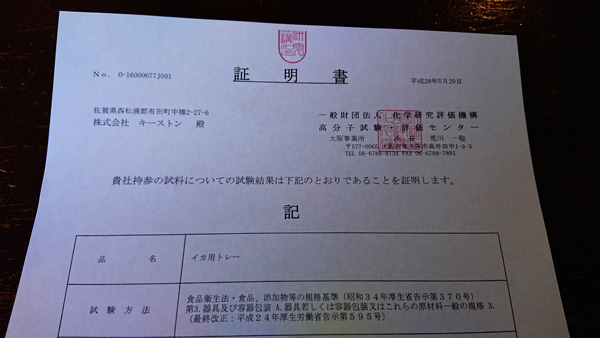
A19.It is a special torobako (fish box) for bringing home the squid you catch as fresh as possible. Many prototypes were made before this product was born. We first built them from Japanese cedar and hinoki cypress and coated them with natural finishes such as kakishibu (persimmon tannin), but since the goal was freshness, after much trial and error we finally settled on aluminum. As shown on the page below, at the time the Saga Prefectural Industrial Technology Center carried out a finite element analysis for us, applying boundary conditions to the partial differential equation of heat conduction, and analyzed the difference between wooden and aluminum boxes theoretically. In 2016, it was tested against the standards of Japan's Food Sanitation Act by a testing body authorized by the Ministry of Health, Labour and Welfare. Many similar products are now on the market; for details, please see our online shop.
Recruitment
Q20.Are you hiring?
A20.Thank you for your interest in KEYSTONE. We are sorry to say that we are not recruiting for any position at present. We will announce it on this website when we are. (As of 1 March 2026)