

How to choose an egi for bigfin reef squid
The size number is the body, the weight is the method, and V0 / V0+ / V1 / V2 is the fall speed
Have you ever hooked a bigfin reef squid (Aori squid) over 4 kg and lost it during the fight? Torn flesh, a hook pulled straight, a snapped shaft—once you have been through that, you want the next one hooked for certain. You start wanting a hook that is big and strong. That is where choosing an egi really begins. Before you look at a table of sizes, look at how big the squid you are up against actually gets.
1. How big does a bigfin reef squid get?
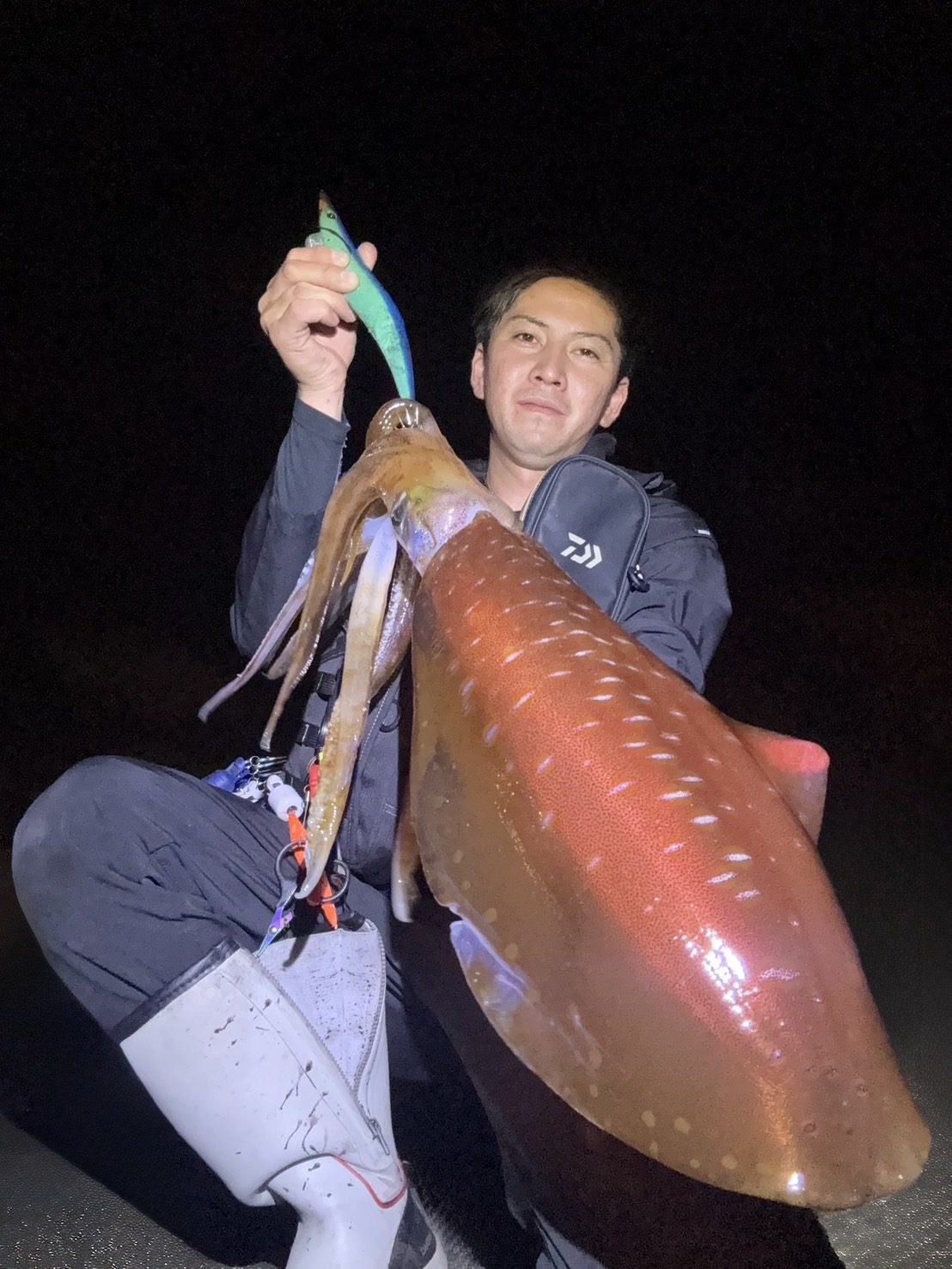
Monster bigfin reef squid over 5 kg really do exist. Past 3 kg you are in what we call “monster” territory, and from there they are not something you can go out and land again and again. Once you decide the size you are after, the egi size follows. The table below is a set of examples from what KEYSTONE has caught on assignment over the past few years.
| Weight of the squid | Egi size | KEYSTONE's record |
|---|---|---|
| 300–500 g | JetChaser size 2.5 (20g) | Goto Nada, Nagasaki, autumn. Fishing for numbers |
| 400–700 g | EgiSharp size 3.5 | Same day. Steady fish in the mid-water |
| 700 g–1.2 kg | EgiSharp size 3.8 | Same day. Picking the better fish on the offshore break |
| 1–2 kg | EgiOita PlaPla size 4.5 (31g) | 1 kg in 45 m of water, Nagasaki (Daybreak size 3.3) |
| 2–3 kg | EgiOita PlaPla size 5.0 (41g) | — |
| Over 3 kg (monster) | EgiOita PlaPla size 7.0 (81g) / Daybreak size 4.0 (39g) | 4.3 kg, 4.4 kg and 4.7 kg — three in a single day at Takeshima, Kagoshima. The oversized KS size 10 hook never opened up |
| 4.4 kg | As above | Mantle length 53 cm |
| 5.4 kg / 5.6 kg | — | Takeshima again. 5.4 kg from the shore, 5.6 kg from a kayak. On display at our direct shop as the squid print “Bamboo Monster” |
The way a person flicks off something tangled round a finger, the squid lets go of the egi in a flash.
Many of you will have seen it happen.
A squid over 3 kg is an animal that has come through the competition to survive. Clever, and easy to lose.
So you tangle it in a multi-row hook so it cannot shake free, and you set a larger hook firmly.
That is what the three- and four-row umbrella hooks on the MonroEgi MonsterTune
are for, and the oversized KS size 10 hook on Daybreak size 4.0 as well.
So why does the size number sort the squid by size? Go on to 2. What the size number decides is the size of the hook.
2. What the size number decides is the size of the hook
The size number of an egi describes how large the egi is. A larger egi is harder for small squid to take hold of, so more of what you hook tends to be large. That tendency is real.
But it is a matter of odds, not a certainty. A squid only about half the length of a size 7.0 egi has taken one. Size reduces the number of small squid; it does not rule them out.
So why go larger? Because a larger egi can carry a larger hook.
When a bigfin reef squid over 4 kg takes the egi, a small hook makes losing it far more likely. With an ordinary egi you hook them and still fail to land them: the flesh tears, the hook opens up, the shaft snaps. To hook them for certain you need a hook that is big and strong. That is why we treat the umbrella hook as one of the most important specifications and develop and produce ours in-house.
Even so, why do so many anglers want to cast a bigger egi in the first place? This one is not about logic. It is about the dream.
A bigfin reef squid over 4 kg is not a fish you can go out and land again and again. Tying on a large egi means giving up the day's numbers and staking everything on one. You keep casting a heavy egi all day for a single squid that may never come. To land a 4 kg fish on this huge egi — one you have never seen anyone around you using — that lift is not something a big count can replace.
The guideline by size is below. It is the one we publish on the EgiOita PlaPla page.
| Squid you are after | Size | Weight | Product |
|---|---|---|---|
| 1–2 kg class | 4.5 | 31g | EgiOita PlaPla |
| 2–3 kg class | 5.0 | 41g | EgiOita PlaPla |
| Monsters over 3 kg | 7.0 | 81g | EgiOita PlaPla |
Most egi on the market stop at size 3.5, and even size 4.0 is uncommon. Size 7.0 weighs 81g and asks something of your rod. This size, which once swept the market, came back in November 2025— because squid over 4 kg, the ones that crush that hook, really are out there.
3. A large hook does not fit on every egi
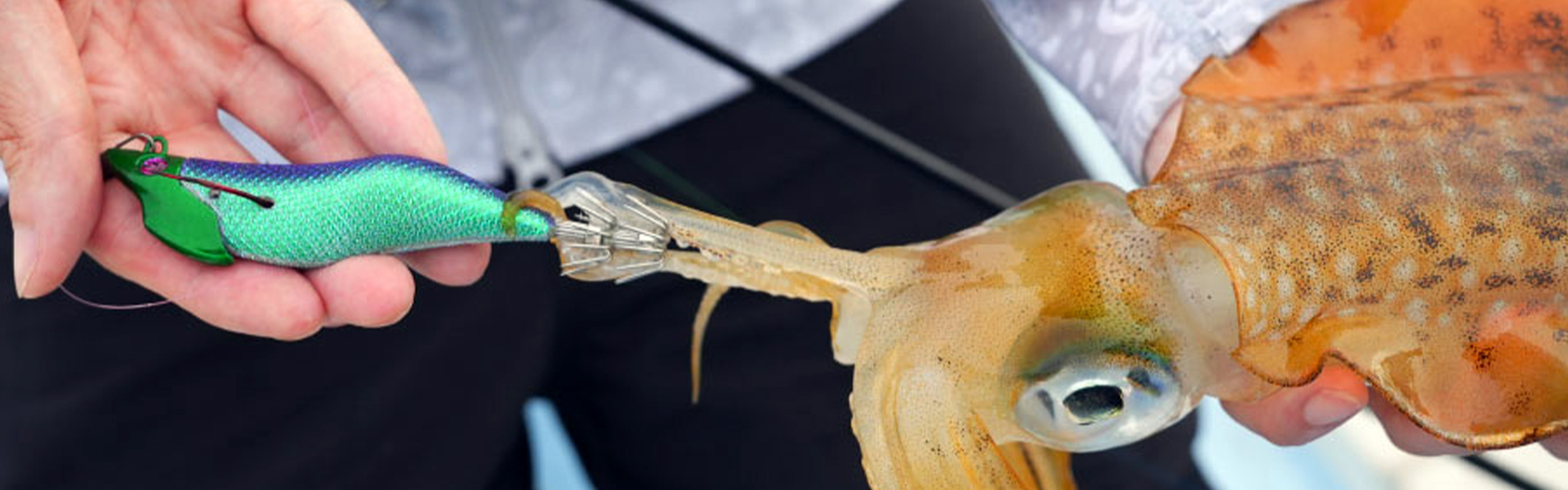
You want a large hook. So why not put one on every egi? Because the size of the body and the size of the hook it can carry are tied together by buoyancy.
Put a large hook on a small egi and the centre of gravity shifts and the posture collapses. An egi that is out of balance lowers your odds of hooking squid.
An egi that is out of balance catches less—something the fishermen who go out every day have confirmed over a number of trips none of us could count.
The other quality: responsiveness
We regard the most important qualities of an egi as its balance during a tensioned fall, and its responsiveness. Responsiveness means the egi telling you that a squid has touched it.
And that only exists while the buoyancy is still alive. Make the hook larger and its weight eats into the buoyancy. An egi whose buoyancy is dead—one balanced by force— not only fails to hold its posture, it stops passing on the touch of a squid. Carrying a large hook and keeping the feel both draw on the same buoyancy.
Our answer: a high-buoyancy body
We want the hook large and the buoyancy left over. What makes both possible is the rigid urethane foam we use. Its high buoyancy absorbs the weight of the hook and still leaves buoyancy behind.
MonroEgi MonsterTune carries large, strong umbrella hooks in multiple stages—three stages on size 4.0 V1, four stages on size 5.0 V2. Several hooks share the weight of the catch, which prevents the tearing that is the greatest problem when fighting squid over 4 kg. An ordinary hollow plastic body cannot hold its balance with four stages on it. The design only works because the material has high buoyancy.
There is a case the other way round. JetChaser size 2.5 carries the KS06 hook, which normally goes on egi of size 3.5 to 4.0 (the same umbrella hook as EgiSharp size 3.5 and 3.8), and still holds a high balance. A large hook on a small egi is the hardest combination of all.
4. Same size, different weight — the weight follows the method
Once the hook and the body are balanced, the next question is weight. This is where most people are caught out. A larger size number does not mean a heavier egi. Line the actual figures up and it becomes obvious.
| Product | Size | Weight | Why that weight |
|---|---|---|---|
| EgiSharp | 3.5 V0 / V0+ 3.8 V0 / V0+ | 15g / 16g 17g / 18g | To show it slowly |
| MonroEgi III | 3.5 V1 | 19g | Standard |
| Daybreak size 3.3 / 4.0 | 3.3 4.0 | 35g 39g | Made for tip-run; heavy because the boat drifts |
| EgiSharp Alpha | 4.3 V0 / V0+ / V1 | 22g / 23g / 24g | Goes after large squid while keeping the fall in check |
| LongEgi 135mm | 4.5 equivalent V0 | 17g | Weed beds; light and slim so it sinks gently |
| EgiOita PlaPla | 4.5 | 31g | The standard for large squid |
| MonroEgi MonsterTune | 5.0 V2 | 52g | Drops fast in deep water |
Size 3.3 (35g) is heavier than size 4.3 (24g). LongEgi 135mm, equivalent to size 4.5 at 17g, is about half the weight of EgiOita PlaPla at the same size 4.5 (31g). A size 4.5 egi normally comes close to 30g.
What sets the weight is not the size number but the way you fish.
- Tip-run—the boat drifts, so the egi is made heavy enough to hold the bottom (Daybreak size 3.3 35g / size 4.0 39g)
- Deep water—heavier still, to drop faster (Daybreak size 4.0 39g, MonroEgi MonsterTune size 5.0 V2 52g)
- Weed beds and shallow water—light, to avoid snagging and to show the egi slowly (LongEgi 135mm 17g-23g)
- Casting from shore—a balance between distance and control (JetChaser 20g-24g)
5. Choosing an egi for casting — does it have the weight to reach?
An egi can be well balanced and responsive. Even so, if you are casting from shore, there is one more thing to check: whether it carries enough weight to be cast a real distance.
However good the balance and the responsiveness, an egi that is too light will not fly. If it does not fly you can only search close to your feet, and for the same time on the water the area you can cover is smaller.
It happens most often with slow-fall models and with small sizes such as size 2.5 or size 3.0. Weight was taken out to sink the egi slowly, or to keep it small—and the casting distance went with it. The egi does exactly what it was made to do, yet it does not reach far enough.
Sinking slowly and still heavy enough to fly
The V0 series of EgiSharp has one of the slowest falls in the industry (9-15 seconds per 1 m) and still weighs 15g in size 3.5 and 17g in size 3.8. Sinking slowly and carrying the weight to fly are held together.
JetChaser is 20g in size 2.5. A small size that still has weight, and it flies in a stable attitude, so it covers a wide area.
If you fish by casting, always check that the egi has the weight to reach. Look only at the size number and the fall speed and this is the part that gets missed.
6. Fall speed: V0, V0+, V1 and V2
When you see V0, V0+, V1 and V2 next to the same size, they mark differences in fall speed. On EgiSharp there are four grades, and they are grades for the free-fall phase.
| Grade | Fall speed | Time to sink 1 m | EgiSharp size 3.5 | EgiSharp size 3.8 |
|---|---|---|---|---|
| V0 | Ultra-slow fall | 9-15 sec | 15g | 17g |
| V0+ | Slow fall | 5-7 sec | 16g | 18g |
| V1 | Standard fall | 3-4 sec | 17g | 19g |
| V2 | Fast fall | 1-2 sec | 20g | 24g |
The same size 3.5 is 15g in V0 and 20g in V2. The body stays the same size; only the speed of the fall changes. Show it slowly in shallow water or when the squid are slow to react; drop it fast in deep water or a strong current. That choice is what the V figure is for.
The grades and their names differ from product to product. On LongEgi 135mm, V0 is slow sinking (17g), V1 medium sinking (21g) and V2 fast sinking (23g). Some of our products go as far as V3. Do not compare V figures across different products. Use them to compare within one product.
We regard the most important qualities of an egi as balance during a tensioned fall, and responsiveness. The V figure is a guide for choosing, not a measure of whether an egi is good.
7. Choosing by place and method
Before the size and the weight are settled, where and how you will fish is usually already decided. You can work backwards from there.
Shore tip-run
JetChaser (size 2.5 20g / 2.6 22g / 3.0 22g / 3.1 24g). It lets you work water 10-20 m deep with light tackle. For deeper water or a fast current you can add a mask sinker from any maker.
Tip-run from a boat
Daybreak size 3.3 (35g) is made for tip-run. For deeper water, Daybreak size 4.0 (39g) falls fast. JetChaser works here in every size (2.5 / 2.6 / 3.0 / 3.1).
Weed beds and shallow water
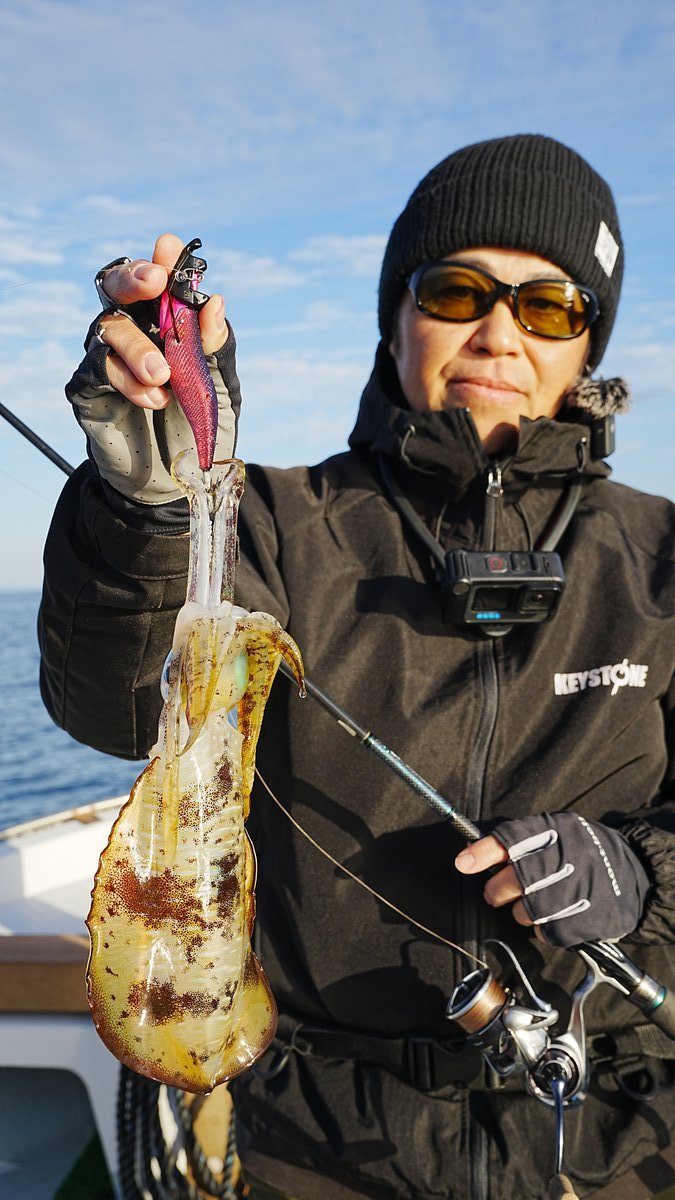
LongEgi 135mm. At 135mm (equivalent to size 4.5) it weighs only 17g-23g. V0 slows the fall so the egi can sit above the weed at a 45-degree angle. The slim, long body picks up the slightest change in the current and shimmers.
EgiSharp in V0 and V0+ also works here— 15g (V0) and 16g (V0+) in size 3.5, 17g and 18g in size 3.8. You can slow the fall without dropping the size.
Deep water
MonroEgi MonsterTune (size 4.0 V1 30g / size 5.0 V2 52g), with three-stage and four-stage umbrella hooks respectively.
When you want to drop faster, EgiSharp in V2 (size 3.5 20g / size 3.8 24g) and LongEgi 135mm in V2 (23g) also work.
Large squid and monsters
EgiOita PlaPla (size 4.5 31g / 5.0 41g / 7.0 81g). From size 4.5 up, small squid are naturally screened out.
Trolling (hikigata)
Hikigata Egi. Made for the trolling method handed down around the coasts of Japan, with the buoyancy controlled precisely so the posture holds both at rest and under tow. Three lines: Goto type, MonroEgi trolling type and Oita type.
Standard eging
EgiSharp (size 3.5 / 3.8, in V0, V0+, V1 and V2), MonroEgi III (size 3.5 V1, 19g) and EgiSharp Alpha (size 4.3, V0 22g / V0+ 23g / V1 24g).
8. Quick reference (the full bigfin reef squid range)
| Product | Size | Weight | Suited to |
|---|---|---|---|
| JetChaser | 2.5 / 2.6 / 3.0 / 3.1 | 20 / 22 / 22 / 24g | Shore tip-run (10-20 m deep) |
| Daybreak size 3.3 | 3.3 | 35g | Made for tip-run |
| EgiSharp | 3.5 / 3.8 V0, V0+, V1, V2 | 3.5: 15 / 16 / 17 / 20g 3.8: 17 / 18 / 19 / 24g | Standard; four fall speeds to choose from |
| MonroEgi III | 3.5 V1 | 19g | Standard; carries on the Yamakawa form |
| Daybreak size 4.0 | 4.0 | 39g | Deep water, fast fall |
| MonroEgi MonsterTune | 4.0 V1 5.0 V2 | 30g 52g | Deep water; three- and four-stage umbrella hooks |
| EgiSharp Alpha | 4.3 V0, V0+, V1 | 22 / 23 / 24g | For large squid |
| LongEgi 135mm | 135mm (4.5 equivalent) V0, V1, V2 | 17 / 21 / 23g | Weed beds and shallow water |
| EgiOita PlaPla | 4.5 / 5.0 / 7.0 | 31 / 41 / 81g | 1-2 kg / 2-3 kg / over 3 kg |
| Hikigata Egi | 4.5 | — | Trolling (Goto, MonroEgi and Oita types) |
All of our products carry an open price. Please ask your retailer for the price.
9. Frequently asked questions
How heavy do bigfin reef squid get?
In KEYSTONE's records: 5.4 kg from the shore and 5.6 kg from a kayak at Takeshima, Kagoshima. At the same place we landed 4.3 kg, 4.4 kg and 4.7 kg in a single day, and one of those was 53 cm of mantle at 4.4 kg. Past 3 kg you are in “monster” territory, and they are not something you can go out and land again and again.
What size do I use when I am fishing for numbers in autumn?
From our record on the Goto Nada, Nagasaki: JetChaser size 2.5 (20g) for 300–500 g fish in numbers, EgiSharp size 3.5 for a steady 400–700 g, and EgiSharp size 3.8 to pick out the 700 g–1.2 kg fish. When the current runs you take the bottom quickly with the heavier egi; when it slackens you show the egi slowly in the mid-water.
Why are bigger squid easier to lose?
The way a person flicks off something tangled round a finger, the squid lets go of the egi in a flash — a squid over 3 kg has come through the competition to survive, it is clever, and it does not come easily. Even hooked, it is easy to lose. That is why you tangle it in a multi-row hook so it cannot shake free and set a larger hook firmly. The three- and four-row umbrella hooks on the MonroEgi MonsterTune and the oversized KS size 10 hook on Daybreak size 4.0 are built for that.
What size egi should I choose for bigfin reef squid?
Choose by the size of the squid you are after. On EgiOita PlaPla we suggest size 4.5 (31g) for the 1-2 kg class, size 5.0 (41g) for the 2-3 kg class and size 7.0 (81g) for monsters over 3 kg. Most egi on the market stop at size 3.5, and even size 4.0 is uncommon.
Why is a larger egi better?
Because it can carry a larger hook. When a squid over 4 kg takes the egi, a small hook makes losing it far more likely. The size of the body and the size of the hook it can carry are tied together by buoyancy, and putting a large hook on a small egi collapses the balance, which lowers your odds. We use high-buoyancy rigid urethane foam to loosen that constraint.
Why do two egi of the same size weigh different amounts?
The size number describes the body, while the weight follows the method. LongEgi 135mm is equivalent to size 4.5 but weighs only 17g-23g; a size 4.5 egi normally comes close to 30g. Conversely Daybreak size 3.3 weighs 35g, more than EgiSharp Alpha size 4.3 at 22-24g.
What do V0, V0+, V1 and V2 mean?
They are fall speed grades. On EgiSharp, V0 is ultra-slow fall, V0+ slow fall, V1 standard fall and V2 fast fall, and they are grades for the free-fall phase. We regard the most important qualities of an egi as balance during a tensioned fall and responsiveness.
Will a bigger egi reduce the number of squid I catch?
It probably will, and that is the point. Egi of size 4.5 and up make it harder for small squid to take hold, raising the share of larger fish. That said, the screening is never certain— a squid only about half the length of a size 7.0 egi has taken one. Use small egi on days when you want numbers and large egi on days when you want size.
Which egi should I use for shore tip-run?
JetChaser is made for shore tip-run. It comes in size 2.5 (20g), 2.6 (22g), 3.0 (22g) and 3.1 (24g), and lets you work water 10-20 m deep with light tackle.
Is there an egi that works well over weed beds?
LongEgi 135mm is made for weed beds. At 135mm (equivalent to size 4.5) it weighs only 17g-23g, and V0 slows the fall so it can sit above the weed at a 45-degree angle.


