

What is sasa-ika?
It is the spear squid (Yari squid) — the name used for it in northern Kyushu
“Sasa-ika” and “yari-ika” are the same squid. Sasa-ika is the name used in northern Kyushu; in standard Japanese it is yari-ika, the spear squid. It comes inshore in the depth of winter. The word that actually causes trouble is “yari-ika” itself: in northern Kyushu, swordtip squid (Kensaki squid) is commonly called yari-ika. One word ends up pointing at two different squid. Let us untangle that first, then get to the fishing.
1. Sasa-ika is the spear squid
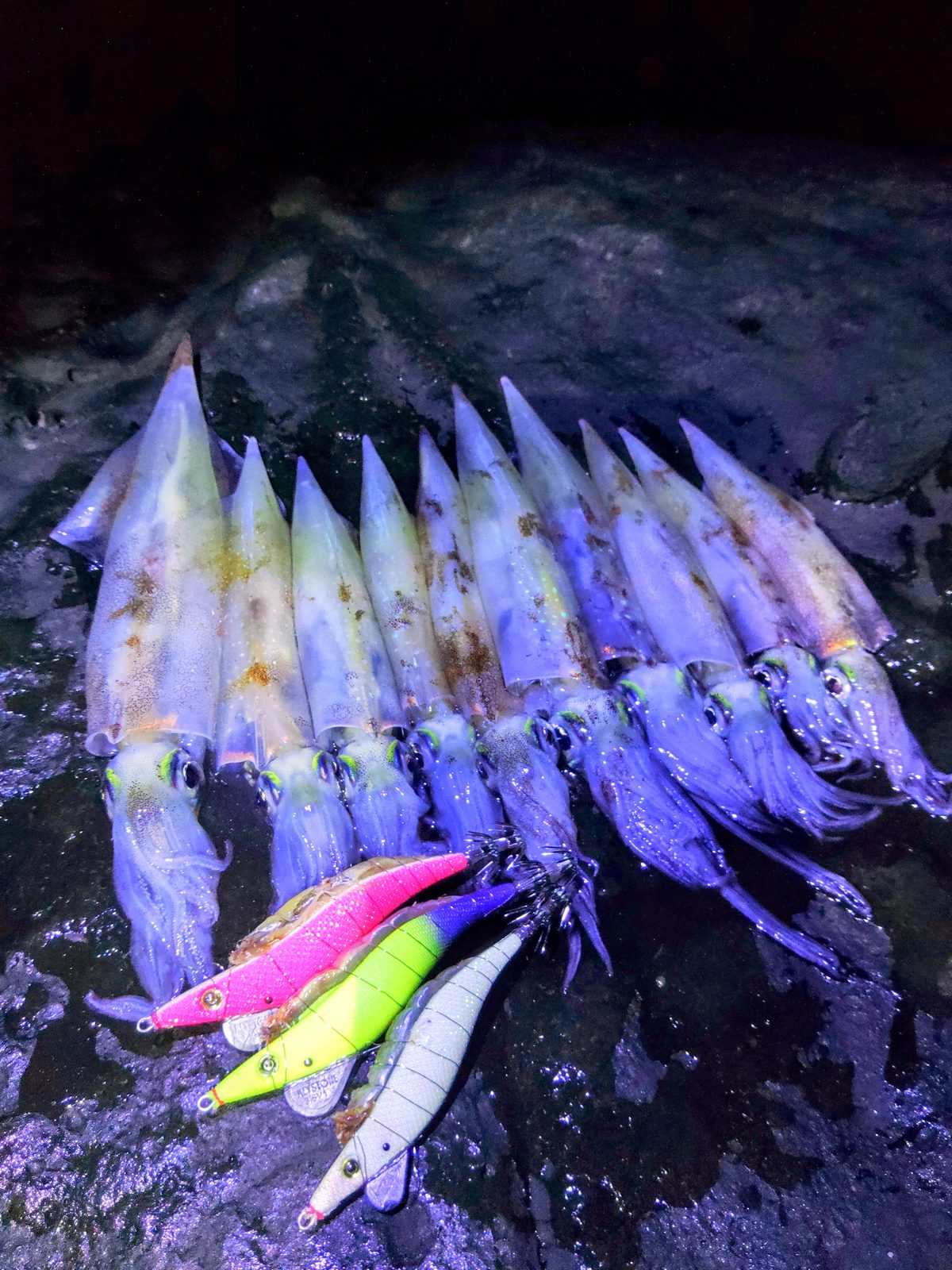
Sasa-ika is the spear squid (Yari squid). Not a different species. It is what people in northern Kyushu (Saga, Nagasaki and Fukuoka prefectures) call it. The name comes from the slim body, shaped like a bamboo leaf — sasa.
Once the bigfin reef squid season is over and squid anglers have disappeared from the breakwaters, this squid comes in from offshore.
2. The confusing word is “yari-ika” itself
In northern Kyushu, swordtip squid (Kensaki squid) is commonly called yari-ika. It is a regional usage. Which means a squid labelled “yari-ika” in a shop there may well be a swordtip.
Meanwhile the squid that comes inshore in midwinter — the spear squid of standard Japanese — is a different species, and in northern Kyushu it is called sasa-ika. So:
| Standard Japanese name | Name in northern Kyushu | Season | How it is fished |
|---|---|---|---|
| Yari-ika (spear squid) | Sasa-ika | Midwinter (Dec–Mar) | Shore and boat |
| Kensaki-ika (swordtip squid) | Yari-ika | March–August | Yodaki, under lights (boat) |
The same word “yari-ika” points to one squid in standard Japanese and to another in northern Kyushu. On the water or at the fish counter, it is worth checking which sense is meant.
For the record, budou-ika — taken under lights in autumn from the Genkai Sea to the San-in coast — is regarded as a seasonal form of swordtip squid. From northern Kyushu to Yamaguchi it is treated as a squid distinct from the swordtip (see What is budou-ika?).
3. When it runs — December to March
December to March: the depth of winter, once the bigfin reef squid season has ended. It is the time of year when squid anglers vanish from the breakwaters — yet shoals of spear squid and Japanese flying squid are moving offshore.
Both species travel in shoals. Hit the timing of a run and a night of ten, fifty or a hundred squid is possible. The other side of that is simple: whether a shoal is in changes everything.
4. From a breakwater, not a boat
For a long time, winter spear squid and Japanese flying squid were something you took from a boat. What made it possible to take them from a breakwater is our Haifukugata / Jado edition, known as the Jado Egi®.
Serious winter squid fishing without getting on a boat — that is what this fishing is really about.
5. Jado eging — an egi fused with bait
Spear squid and Japanese flying squid are warier than bigfin reef squid. With an ordinary egi they take hold for a moment and let go. Float fishing with bait draws them well, but the depth is fixed and you lose mobility.
The Jado Egi fuses the mobility of an egi with the drawing power of bait. You search a wide area by jerking, while the smell, taste and feel of the bait create a situation where a squid that has taken hold does not let go. The longer they hold on, the more chances you get to set the hook.
Matching the fall speed to the situation
The Jado Egi comes in V0, V1, V2 and V3 fall speeds (size 3.0 in V0 11g and V1 12g; size 3.5 in V0, V1, V2 and V3). Slow for shallow water or a slow day, fast for deep water or a strong current.
The grades differ from product to product. EgiSharp, for bigfin reef squid, has four grades — V0, V0+, V1 and V2 — while the Jado Egi has no V0+ and has a V3 instead. Do not compare V figures across different products.
6. Tackle and bait
Tackle
| Item | Guideline |
|---|---|
| Rod | An eging rod of about 7ft to 9ft |
| Reel | A small spinning reel, 2000 to 3000 size |
| PE line | No. 0.4 to No. 1.0, 100 m or more |
| Leader | Fluorocarbon No. 1.5 to No. 3.0, 1 m to 1.5 m |
| Knot | FG knot or similar |
That said, jado eging has no fine rules. Fish it with whatever tackle you like.
Bait
Chicken breast fillet, kibinago and similar small baitfish.
- Salt the chicken and let it rest in the fridge for a few days — it firms up and lasts longer on the hook
- Bind both ends of the bait firmly with wire. That is the key to both bait retention and results
Photographs and the step-by-step method are on the Jado Egi product page.
7. If you fish from a boat
The dozuki rig for winter spear squid from a boat is in our yodaki squid rig diagrams (“Basic rig for winter spear squid and spring mugi squid”). Spear squid and mugi squid prefer something slim, and the diagram gives the main line, droppers, sinker and spacing in figures.
8. Frequently asked questions
What is sasa-ika?
It is the spear squid (Yari squid). Sasa-ika is the name used for it in northern Kyushu, and the squid comes inshore in midwinter. It is not a different species — it is the same squid under another name.
What is the difference between sasa-ika and yari-ika?
There is none. They are the same squid. The word that causes confusion is yari-ika itself: in northern Kyushu, swordtip squid is commonly called yari-ika. The spear squid of standard Japanese — that is, sasa-ika — is a different species from it.
Is the squid sold as yari-ika in shops the same as sasa-ika?
In northern Kyushu (Saga, Nagasaki and Fukuoka prefectures) swordtip squid is commonly called yari-ika, so a squid labelled yari-ika in a shop there may be a swordtip. The spear squid that comes inshore in midwinter is a different species, and there it is called sasa-ika.
When can you catch sasa-ika?
From December to March — the depth of winter, once the bigfin reef squid season is over. Squid anglers disappear from the breakwaters, but shoals of spear squid and Japanese flying squid are moving offshore.
Can you catch sasa-ika from shore?
Yes. Winter squid that could once only be taken from a boat can now be taken from a breakwater, and that is what the Jado Egi® was made for. It combines the mobility of an egi with the drawing power of bait.
What bait is used for jado eging?
Chicken breast fillet or small baitfish such as kibinago. Salting the chicken and letting it rest in the fridge for a few days firms it up and makes it last longer on the hook. Binding both ends of the bait firmly with wire is the key to both bait retention and results.
What tackle do I need?
A 7ft to 9ft eging rod, a small 2000–3000 size spinning reel, 100 m or more of PE line in No. 0.4 to No. 1.0, and 1 m to 1.5 m of fluorocarbon leader in No. 1.5 to No. 3.0, joined with an FG knot or similar. That said, jado eging has no fine rules.


