Fishing Gear
Products



Products
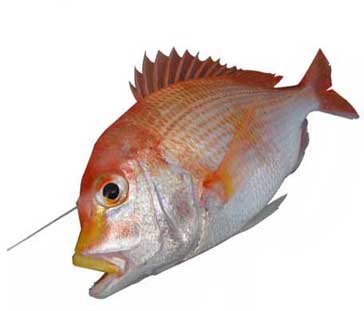
Normally, a fish stiffens with rigor mortis about four hours after death, and after this stiffening it progresses to aging and then decay.
Fishermen have long practiced shinkeijime (nerve spiking) using piano wire or stainless steel wire.
However, threading these wires along the spinal cord was difficult because the slime on the fish made them slip, so it required a skilled technique.
Moreover, a rigid material like piano wire was extremely difficult to run through a fish's curved spinal cord.
So, by applying a special textured (ridged) finish to the surface of an elastic, straight wire, we made it possible for even an inexperienced amateur to perform nerve spiking relatively easily.
With the arrival of this new tool, it became possible to spike everything from small horse mackerel to giant bluefin tuna with relative ease.
To handle a wide variety of fish, the lineup ranges from 0.8 to 2.5 mm in thickness and 30 to 150 cm in length.
We also accept custom orders for special thicknesses and lengths. Please feel free to inquire.
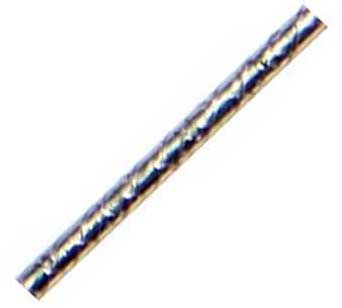
As you can probably see from the photo on the left, we apply a special anti-slip textured finish.
This came about because, when performing nerve spiking, the fish's slime inevitably makes the tool slip and hard to work with, and furthermore, considering that it is even more effective not only to destroy the nerve but also to scrape and remove it, we decided to apply a special textured finish.
We have actually run tests countless times and incorporated the opinions of fishermen.
A genuine nerve-spiking tool approved by the pros in the field.
Enjoy the flavor of a high-class restaurant right at home!
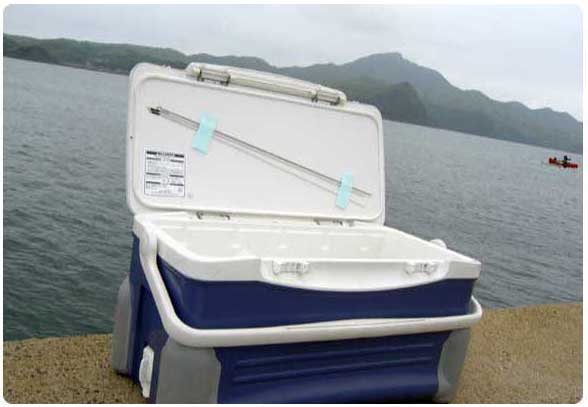
Here is how to carry it.
As shown in the photo, we recommend attaching it to the underside of the cooler lid with hook-and-loop tape or similar; it stays out of the way and can be taken out immediately whenever you need it.
When using it for light game fishing such as ajing (horse mackerel) or for rockfish (mebaru), you can also attach it to a pin-on reel worn on your waist bag to carry it. However, please be careful not to injure yourself.
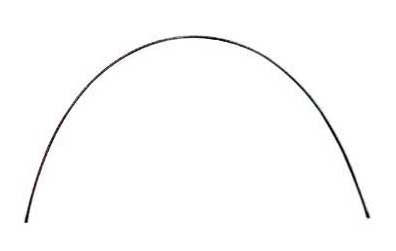
A nerve-spiking wire is hard to insert if it is either too soft or too hard.
One with moderate softness and toughness is well suited for nerve spiking.
As shown in the figure on the right, the KeyStone shinkeijime returns to its original shape even after being bent, and it also has the softness needed to slide smoothly through the interior of a fish's curved nerve canal.
If you try to force it in, the load concentrates at a single point of the shinkeijime and it may bend, so please be careful.
| Fish Size | Shinkeijime Size |
|---|---|
| 40 cm – 60 cm | 1.0 mm 50 cm |
| 60 – 90 cm | 1.2 mm 80 cm |
| Fish Size | Shinkeijime Size |
|---|---|
| 30 cm – 40 cm | 0.8 mm 30 cm |
| 40 cm – 60 cm | 1.0 mm 50 cm |
| Fish Size | Shinkeijime Size |
|---|---|
| 20 cm – 35 cm | 0.8 mm 30 cm |
| 35 cm – 50 cm | 0.8 mm 50 cm |
| Fish Size | Shinkeijime Size |
|---|---|
| 40 cm – 60 cm | 1.0 mm 50 cm |
| 60 cm – 80 cm | 1.2 mm 80 cm |
| 80 cm – 100 cm | 1.5 mm 100 cm |
| 100 cm – 150 cm | 2.0 mm 150 cm |
| Fish Size | Shinkeijime Size |
|---|---|
| 80 cm – 130 cm (20–50 kg class) | 1.5 mm 130 cm |
| 100 cm – 160 cm (50–80 kg class) | 2.0 mm 150 cm |
|
150 cm – 200 cm (100 kg class) *For sizes exceeding 150 cm, shipping alone may come to nearly 5,000 yen. |
2.5 mm 200 cm (special custom order) *For sizes exceeding 150 cm, shipping alone may come to nearly 5,000 yen. |
*These are only rough guides. Depending on the species and individual variation, some thicknesses may be harder to insert into the nerve, so we recommend bringing several thicknesses and lengths with you.
If the shinkeijime just won't go into the nerve, you can widen the hole first with a thicker (1.5 mm) shinkeijime, and then perform the nerve spiking fairly easily. (Using the 0.8 mm 30 cm shinkeijime.)
Even tuna gets nerve-spiked to be enjoyed at its best. (Using the 2.0 mm 150 cm shinkeijime.) This video was provided by AP Company, who aim to revitalize the fishing industry through a revolution in fish distribution. (C) AP Company
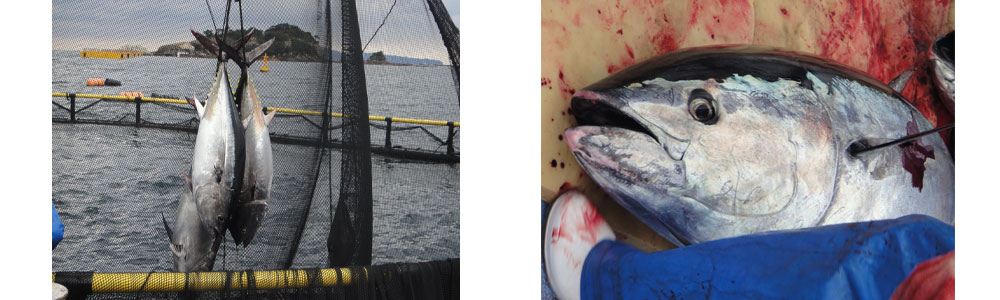
Sojitz Tuna Farm Takashima Co., Ltd. raises farmed bluefin tuna on Takashima Island in Matsuura City, Nagasaki Prefecture. They launched the business in September 2008 and began shipping at the end of 2010. Nerve spiking (nerve removal) of the tuna is an important extra step for maintaining freshness, and they carefully perform "bleeding → nerve spiking → gutting" on each and every fish. By taking this extra step, they are able to ship consistently high-quality bluefin tuna. Because the tuna at Takashima are raised in an ideal environment for tuna farming—good tidal flow, low winter water temperatures, high dissolved oxygen, and little variation in salinity—they grow into firm, high-quality tuna. In addition, thanks to the Takashima Hizen Ohashi bridge that opened in 2009, access to major cities is good, and the fish are shipped without losing freshness. You can buy Takashima-raised bluefin tuna as blocks at the roadside station "Takarajima" at the foot of the Takashima Hizen Ohashi bridge, and you can also eat a tuna rice bowl at its restaurant. It is so delicious you would never guess it is farmed. When you visit Takashima, please be sure to try the Takashima-raised bluefin tuna.
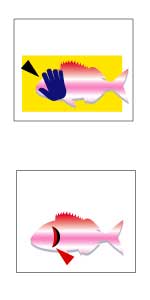
Place the fish on something soft, like a sponge, so it cannot thrash about, hold the head firmly, and insert the shinkeijime.
When the spike goes in cleanly, you can see the fish's color change instantly starting from the spot where you inserted it.
It will also twitch and convulse, so it is visibly obvious.
After inserting the spike, cut the gills (detach the base of the gills), bleed the fish, and rinse it with water.
Soaking it for about 10 minutes in slightly chilled seawater lets the blood drain thoroughly and lowers the fish's body temperature.
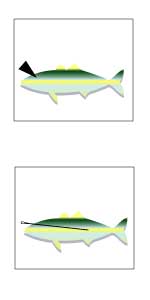
The spot to insert the shinkeijime is at the center between the eyes, just slightly above that center.
It is the softer area right below the slight bulge on the fish.
First, use a hand gaff or pick to pierce that spot 1–2 cm and make a pilot hole.
Then, using a small-diameter 1 mm–1.2 mm shinkeijime, push it through toward the tail at a slightly upward angle along the fish's spinal cord, taking care not to let it slip.
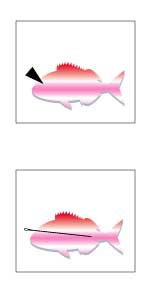
Insert a guide shinkeijime about 1–2 cm into the nose of the red sea bream and find the spot that convulses.
The place where the fish reacts and twitches is the nerve.
Pull out the guide shinkeijime, and when you insert a 1 mm shinkeijime at a slightly upward angle, it connects to the fish's spinal cord.
After that, push it through toward the tail slowly, taking care not to let it slip.
The nose-insertion method works well once you get used to it, but if you are not used to it, insert the shinkeijime using the same method as for the horse mackerel, chicken grunt, blackfish, and yellowtail above.
*2 pieces per bag.
| Total Length (cm) | Retail Price | Item No./JAN |
|---|---|---|
| 30 cm | Open Price |
SIME08-030 4540019101436 |
| 50 cm | Open Price |
SIME08-050 4540019101443 |
| 80 cm | Open Price |
SIME08-080 4540019101450 |
*2 pieces per bag.
| Total Length (cm) | Retail Price | Item No./JAN |
|---|---|---|
| 30 cm | Open Price |
SIME10-030 4540019050093 |
| 50 cm | Open Price |
SIME10-050 4540019050109 |
| 80 cm | Open Price |
SIME10-080 4540019050116 |
| 100 cm | Open Price |
SIME10-100 4540019050123 |
*2 pieces per bag.
| Total Length (cm) | Retail Price | Item No./JAN |
|---|---|---|
| 30 cm | Open Price |
SIME12-030 4540019050130 |
| 50 cm | Open Price |
SIME12-050 4540019050147 |
| 80 cm | Open Price |
SIME12-080 4540019050154 |
| 100 cm | Open Price |
SIME12-100 4540019050161 |
*30 cm–100 cm come 2 pieces per bag; 130 cm and 150 cm come 1 piece per bag.
| Total Length (cm) | Retail Price | Item No./JAN |
|---|---|---|
| 30 cm | Open Price |
SIME15-030 4540019101429 |
| 50 cm | Open Price |
SIME15-050 4540019054848 |
| 80 cm | Open Price |
SIME15-080 4540019054862 |
| 100 cm | Open Price |
SIME15-100 4540019054879 |
| 130 cm | Open Price |
SIME15-130 4540019208951 |
| 150 cm | Open Price |
SIME15-150 4540019208968 |
*1 piece per bag.
| Total Length (cm) | Retail Price | Item No./JAN |
|---|---|---|
| 100 cm | Open Price |
SIME18-100 4540019214969 |
| 130 cm | Open Price |
SIME18-130 4540019214976 |
| 150 cm | Open Price |
SIME18-150 4540019214983 |
*The 2.0 mm comes 1 piece per bag.
| Total Length (cm) | Retail Price | Item No./JAN |
|---|---|---|
| 100 cm | Open Price |
SIME20-100 4540019201822 |
| 130 cm | Open Price |
SIME20-130 4540019214990 |
| 150 cm | Open Price |
SIME20-150 4540019201839 |
*The 2.5 mm comes 1 piece per bag.
| Total Length (cm) | Retail Price | Item No./JAN |
|---|---|---|
| 100 cm | Open Price |
SIME25-100 4540019201846 |
| 150 cm | Open Price |
SIME25-150 4540019201853 |


